Marshall Mix Design
The basic concepts of the Marshall mix design method were originally developed by Bruce Marshall of the Mississippi Highway Department around 1939 and then refined by the U.S. Army. Currently, the Marshall method is used in some capacity by about 38 states. The Marshall method seeks to select the asphalt binder content at a desired density that satisfies minimum stability and range of flow values
This section consists of a brief history of the Marshall mix design method followed by a general outline of the actual method. This outline emphasizes general concepts and rationale over specific procedures. Detailed procedures vary from state-to-state but typical procedures are available in the following documents:
- Roberts, F.L.; Kandhal, P.S.; Brown, E.R.; Lee, D.Y. and Kennedy, T.W. (1996[2]). Hot Mix Asphalt Materials, Mixture Design, and Construction. National Asphalt Pavement Association Education Foundation. Lanham, MD.
- National Asphalt Pavement Association. (1982[3]). Development of Marshall Procedures for Designing Asphalt Paving Mixtures, Information Series 84. National Asphalt Pavement Association. Lanham, MD.
- Asphalt Institute. (1997[4]). Mix Design Methods for Asphalt, 6th ed., MS-02. Asphalt Institute. Lexington, KY.
Marshall Method History
(from White, 1985[1])
During World War II, the U.S. Army Corps of Engineers (USCOE) began evaluating various HMA mix design methods for use in airfield pavement design. Motivation for this search came from the ever-increasing wheel loads and tire pressures produced by larger and larger military aircraft. Early work at the U.S. Army Waterways Experiment Station (WES) in 1943 had the objective of developing:
“…a simple apparatus suitable for use with the present California Bearing Ratio (CBR) equipment to design and control asphalt paving mixtures…”
The most promising method eventually proved to be the Marshall Stability Method developed by Bruce G. Marshall at the Mississippi Highway Department in 1939. WES took the original Marshall Stability Test and added a deformation measurement (using a flow meter) that was reasoned to assist in detecting excessively high asphalt contents. This appended test was eventually recommended for adoption by the U.S. Army because:
- It was designed to stress the entire sample rather than just a portion of it.
- It facilitated rapid testing with minimal effort.
- It was compact, light and portable.
- It produced densities reasonably close to field densities.
WES continued to refine the Marshall method through the 1950s with various tests on materials, traffic loading and weather variables. Today the Marshall method, despite its shortcomings, is probably the most widely used mix design method in the world. It has probably become so widely used because (1) it was adopted and used by the U.S. military all over the world during and after WWII and (2) it is simple, compact and inexpensive.
Marshall Mix Design Procedure
The Marshall mix design method consists of 6 basic steps:
- Aggregate selection.
- Asphalt binder selection.
- Sample preparation (including compaction).
- Stability determination using the Hveem Stabilometer.
- Density and voids calculations.
- Optimum asphalt binder content selection.
Aggregate Selection
Although Hveem did not specifically develop an aggregate evaluation and selection procedure, one is included here because it is integral to any mix design. A typical aggregate evaluation for use with either the Hveem or Marshall mix design methods includes three basic steps (Roberts et al., 1996[2]):
- Determine aggregate physical properties. This consists of running various tests to determine properties such as:
- Determine other aggregate descriptive physical properties. If the aggregate is acceptable according to step #1, additional tests are run to fully characterize the aggregate. These tests determine:
- Perform blending calculations to achieve the mix design aggregate gradation. Often, aggregates from more than one source or stockpile are used to obtain the final aggregate gradation used in a mix design. Trial blends of these different gradations are usually calculated until an acceptable final mix design gradation is achieved. Typical considerations for a trial blend include:
- All gradation specifications must be met. Typical specifications will require the percent retained by weight on particular sieve sizes to be within a certain band.
- The gradation should not be too close to the FHWA’s 0.45 power maximum density curve. If it is, then the VMA is likely to be too low. Gradation should deviate from the FHWA’s 0.45 power maximum density curve, especially on the 2.36 mm (No. 8) sieve.
Asphalt Binder Evaluation
The Marshall test does not have a common generic asphalt binder selection and evaluation procedure. Each specifying entity uses their own method with modifications to determine the appropriate binder and, if any, modifiers. Binder evaluation can be based on local experience, previous performance or a set procedure. The most common procedure is the Superpave PG binder system. Once the binder is selected, several preliminary tests are run to determine the asphalt binder’s temperature-viscosity relationship.
Sample Preparation
The Marshall method, like other mix design methods, uses several trial aggregate-asphalt binder blends (typically 5 blends with 3 samples each for a total of 15 specimens), each with a different asphalt binder content. Then, by evaluating each trial blend’s performance, an optimum asphalt binder content can be selected. In order for this concept to work, the trial blends must contain a range of asphalt contents both above and below the optimum asphalt content. Therefore, the first step in sample preparation is to estimate an optimum asphalt content. Trial blend asphalt contents are then determined from this estimate.
Optimum Asphalt Binder Content Estimate
The Marshall mix design method can use any suitable method for estimating optimum asphalt content and usually relies on local procedures or experience.
Sample Asphalt Binder Contents
Based on the results of the optimum asphalt binder content estimate, samples are typically prepared at 0.5 percent by weight of mix increments, with at least two samples above the estimated asphalt binder content and two below.
Compaction with the Marshall Hammer
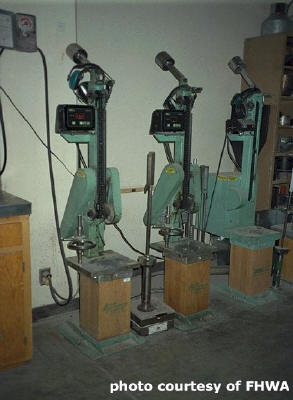
Each sample is then heated to the anticipated compaction temperature and compacted with a Marshall hammer, a device that applies pressure to a sample through a tamper foot (Figure 1). Some hammers are automatic and some are hand operated. Key parameters of the compactor are:
- Sample size = 102 mm (4-inch) diameter cylinder 64 mm (2.5 inches) in height (corrections can be made for different sample heights)
- Tamper foot = Flat and circular with a diameter of 98.4 mm (3.875 inches) corresponding to an area of 76 cm2 (11.8 in2).
- Compaction pressure = Specified as a 457.2 mm (18 inches) free fall drop distance of a hammer assembly with a 4536 g (10 lb.) sliding weight.
- Number of blows = Typically 35, 50 or 75 on each side depending upon anticipated traffic loading.
- Simulation method = The tamper foot strikes the sample on the top and covers almost the entire sample top area. After a specified number of blows, the sample is turned over and the procedure repeated.
Figure 1. Marshall drop hammers.
The standard Marshall method sample preparation procedure is contained in:
- AASHTO T 245: Resistance to Plastic Flow of Bituminous Mixtures Using the Marshall Apparatus
The Marshall Stability and Flow Test
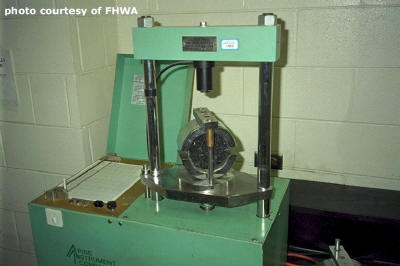
The Marshall stability and flow test provides the performance prediction measure for the Marshall mix design method. The stability portion of the test measures the maximum load supported by the test specimen at a loading rate of 50.8 mm/minute (2 inches/minute). Basically, the load is increased until it reaches a maximum then when the load just begins to decrease, the loading is stopped and the maximum load is recorded.
During the loading, an attached dial gauge measures the specimen’s plastic flow as a result of the loading (Figure 2). The flow value is recorded in 0.25 mm (0.01 inch) increments at the same time the maximum load is recorded.
Figure 2. Marshall stability testing apparatus.
Typical Marshall design stability and flow criteria are shown in Table 1.
| Mix Criteria | Light Traffic (< 104 ESALs) | Medium Traffic (104 – 106 ESALs) | Heavy Traffic (> 106 ESALs) | |||
| Min. | Max. | Min. | Max. | Min. | Max. | |
| Compaction (number of blows on each end of the sample) | 35 | 50 | 75 | |||
| Stability (minimum) | 2224 N (500 lbs.) | 3336 N (750 lbs.) | 6672 N (1500 lbs.) | |||
| Flow (0.25 mm (0.01 inch)) | 8 | 20 | 8 | 18 | 8 | 16 |
| Percent Air Voids | 3 | 5 | 3 | 5 | 3 | 5 |
One standard Marshall mix design procedure is:
- AASHTO T 245: Resistance to Plastic Flow of Bituminous Mixtures Using Marshall Apparatus
Density and Voids Analysis
All mix design methods use density and voids to determine basic HMA physical characteristics. Two different measures of densities are typically taken:
- Bulk specific gravity (Gmb).
- Theoretical maximum specific gravity (TMD, Gmm).
These densities are then used to calculate the volumetric parameters of the HMA. Measured void expressions are usually:
- Air voids (Va), sometimes expressed as voids in the total mix (VTM)
- Voids in the mineral aggregate (VMA)
- Voids filled with asphalt (VFA)
Generally, these values must meet local or State criteria.
| Nominal Maximum Particle Size | Minimum VMA (percent) | |
| (mm) | (U.S.) | |
| 63 | 2.5 inch | 11 |
| 50 | 2.0 inch | 11.5 |
| 37.5 | 1.5 inch | 12 |
| 25.0 | 1.0 inch | 13 |
| 19.0 | 0.75 inch | 14 |
| 12.5 | 0.5 inch | 15 |
| 9.5 | 0.375 inch | 16 |
| 4.75 | No. 4 sieve | 18 |
| 2.36 | No. 8 sieve | 21 |
| 1.18 | No. 16 sieve | 23.5 |
Selection of Optimum Asphalt Binder Content
The optimum asphalt binder content is finally selected based on the combined results of Marshall stability and flow, density analysis and void analysis (Figure 3). Optimum asphalt binder content can be arrived at in the following procedure (Roberts et al., 1996[2]):
- Plot the following graphs:
- Asphalt binder content vs. density. Density will generally increase with increasing asphalt content, reach a maximum, then decrease. Peak density usually occurs at a higher asphalt binder content than peak stability.
- Asphalt binder content vs. Marshall stability. This should follow one of two trends:
- * Stability increases with increasing asphalt binder content, reaches a peak, then decreases.
- * Stability decreases with increasing asphalt binder content and does not show a peak. This curve is common for some recycled HMA mixtures.
- Asphalt binder content vs. flow.
- Asphalt binder content vs. air voids. Percent air voids should decrease with increasing asphalt binder content.
- Asphalt binder content vs. VMA. Percent VMA should decrease with increasing asphalt binder content, reach a minimum, then increase.
- Asphalt binder content vs. VFA. Percent VFA increases with increasing asphalt binder content.
- Determine the asphalt binder content that corresponds to the specifications median air void content (typically this is 4 percent). This is the optimum asphalt binder content.
- Determine properties at this optimum asphalt binder content by referring to the plots. Compare each of these values against specification values and if all are within specification, then the preceding optimum asphalt binder content is satisfactory. Otherwise, if any of these properties is outside the specification range the mixture should be redesigned.
Figure 3. Selection of optimum asphalt binder content example (from Roberts et al., 1996[2]).
Footnotes
- Marshall Procedures for Design and Quality Control of Asphalt Mixtures. Asphalt Paving Technology: Proceedings, vol. 54. Association of Asphalt Paving Technologists Technical Sessions, 11-13 February 1985. San Antonio, TX. pp. 265-284.↵
- Hot Mix Asphalt Materials, Mixture Design, and Construction. National Asphalt Pavement Association Education Foundation. Lanham, MD.↵
- National Asphalt Pavement Association. (1982). Development of Marshall Procedures for Designing Asphalt Paving Mixtures, Information Series 84. National Asphalt Pavement Association. Lanham, MD.↵
- Mix Design Methods for Asphalt, 6th ed., MS-02. Asphalt Institute. Lexington, KY.↵
- Mix Design Methods for Asphalt Concrete and Other Hot-Mix Types. Manual Series No. 2 (MS-2). Asphalt Institute. Lexington, KY.↵

http://www.setestindia.com/marshall-stability-test-apparatus.html
ReplyDelete