2017

Friday, July 7, 2017

Concrete Mix Design with Modification/Corrections option


Concrete mix design is required to achieve target strength in structures. Concrete Mix design of M20, M25, M30 grade of concrete can be calculated from example below.

CONCRETE MIX DESIGN CALCULATION FOR M20 M25 M30 WITH EXAMPLE

Data Required for Concrete Mix Design

(i) Concrete Mix Design Stipulation

(a) Characteristic compressive strength required in the field at 28 days grade designation — M 25
(b) Nominal maximum size of aggregate — 20 mm
(c) Shape of CA — Angular
(d) Degree of workability required at site — 50-75 mm (slump)
(e) Degree of quality control available at site — As per IS:456
(f) Type of exposure the structure will be subjected to (as defined in IS: 456) — Mild
(g) Type of cement: PSC conforming IS:455
(h) Method of concrete placing: pump able concrete

(ii) Test data of material (to be determined in the laboratory)

(a) Specific gravity of cement — 3.15
(b) Specific gravity of FA — 2.64
(c) Specific gravity of CA — 2.84
(d) Aggregate are assumed to be in saturated surface dry condition.
(e) Fine aggregates confirm to Zone II of IS – 383

Procedure for Concrete Mix Design of M25 Grade Concrete

Step 1 — Determination Of Target Strength

Himsworth constant for 5% risk factor is 1.65. In this case standard deviation is taken from IS:456 against M 20 is 4.0.

ftarget = fck + 1.65 x S  = 25 + 1.65 x 4.0 = 31.6 N/mm2
Where,
S = standard deviation in N/mm2 = 4 (as per table -1 of IS 10262- 2009)

Step 2 — Selection of water / cement ratio:-

From Table 5 of IS 456, (page no 20)
Maximum water-cement ratio for Mild exposure condition = 0.55
Based on experience, adopt water-cement ratio as 0.5.
0.5<0.55, hence OK.

Step 3 — Selection of Water Content

From Table 2 of IS 10262- 2009,
Maximum water content = 186 Kg (for Nominal maximum size of aggregate — 20 mm)


Table for Correction in water content
Parameters
Values as per Standard reference condition
Values as per Present Problem
Departure
Correction in Water Content
Slump
25-50 mm
50-75
25
(+3/25) x 25 = +3
Shape of Aggregate
Angular
Angular
Nil
Total
+3
Estimated water content = 186+ (3/100) x 186 = 191.6 kg /m3

Step 4 — Selection of Cement Content

Water-cement ratio = 0.5
Corrected water content = 191.6 kg /m3
Cement content =
From Table 5 of IS 456,
Minimum cement Content for mild exposure condition = 300 kg/m3
383.2 kg/m3 > 300 kg/m3, hence, OK.

This value is to be checked for durability requirement from IS: 456.

In the present example against mild exposure and for the case of reinforced concrete the minimum cement content is 300 kg/m3 which is less than 383.2 kg/m3. Hence cement content adopted = 383.2 kg/m3.

As per clause 8.2.4.2 of IS: 456
Maximum cement content = 450 kg/m3.

Step 5: Estimation of Coarse Aggregate proportion:-

From Table 3 of IS 10262- 2009,

For Nominal maximum size of aggregate = 20 mm,
Zone of fine aggregate = Zone II
And For w/c = 0.5
Volume of coarse aggregate per unit volume of total aggregate = 0.62

Table for correction in estimation of coarse aggregate proportion
Parameter
Values as per Standard reference condition
Values as per present problem
Departure
Correction in Coarse Aggregate proportion
Remarks
W/c
0.5
0.5
Nil
See Note 1
Workability
pump able concrete
-10%
See Note 2
Total
-10%
               

Note 1: For every ±0.05 change in w/c, the coarse aggregate proportion is to be changed by 0.01. If the w/c is less than 0.5 (standard value), volume of coarse aggregate is required to be increased to reduce the fine aggregate content. If the w/c is more than 0.5, volume of coarse aggregate is to be reduced to increase the fine aggregate content. If coarse aggregate is not angular, volume of coarse aggregate may be required to be increased suitably, based on experience.

Note 2: For pump able concrete or congested reinforcement the coarse aggregate proportion may be reduced up to 10%.

Hence,

Volume of coarse aggregate per unit volume of total aggregate = 0.62 x 90% = 0.558
Volume of fine aggregate = 1 – 0.558 = 0.442

Step 6: Estimation of the mix ingredients

a) Volume of concrete = 1 m3
b) Volume of cement = (Mass of cement / Specific gravity of cement) x (1/100)
= (383.2/3.15) x (1/1000) = 0.122 m3

c) Volume of water = (Mass of water / Specific gravity of water) x (1/1000)
= (191.6/1) x (1/1000) = 0.1916 m3
d) Volume of total aggregates = a – (b + c ) = 1 – (0.122 + 0.1916) = 0.6864 m3
e) Mass of coarse aggregates = 0.6864 x 0.558 x 2.84 x 1000 = 1087.75 kg/m3
f) Mass of fine aggregates = 0.6864 x 0.442 x 2.64 x 1000 = 800.94 kg/m3

Concrete Mix proportions for Trial Mix 1

Cement = 383.2 kg/m3
Water = 191.6 kg/m3
Fine aggregates = 800.94 kg/m3
Coarse aggregate = 1087.75 kg/m3
W/c = 0.5

For trial -1 casting of concrete in lab, to check its properties.

It will satisfy durability & economy.

For casting trial -1, mass of ingredients required will be calculated for 4 no’s cube assuming 25% wastage.

Volume of concrete required for 4 cubes = 4 x (0.153 x1.25) = 0.016878 m3

Cement = (383.2 x 0.016878) kg/m3 = 6.47 kg
Water = (191.6 x 0.016878) kg/m3 =3.23 kg
Coarse aggregate = (1087.75 x 0.016878) kg/m3 =18.36 kg
Fine aggregates = (800.94 x 0.016878) kg/m3 = 13.52 kg

Step 7: Correction due to absorbing / moist aggregate:-

Since the aggregate is saturated surface dry condition hence no correction is required.


Step 8: Concrete Trial Mixes:-

Concrete Trial Mix 1:

The mix proportion as calculated in Step 6 forms trial mix1. With this proportion, concrete is manufactured and tested for fresh concrete properties requirement i.e. workability, bleeding and finishing qualities.

In this case,

Slump value = 25 mm
Compaction Factor = 0.844

So, from slump test we can say,

Mix is cohesive, workable and had a true slump of about 25 mm and it is free from segregation and bleeding.

Desired slump = 50-75 mm

So modifications are needed in trial mix 1 to arrive at the desired workability.

Concrete Trial Mix 2:

To increase the workability from 25 mm to 50-75 mm an increase in water content by +3% is to be made.

The corrected water content = 191.6 x 1.03 = 197.4 kg.

As mentioned earlier to adjust fresh concrete properties the water cement ratio will not be changed. Hence

Cement Content = (197.4/0.5) = 394.8 kg/m3

Which also satisfies durability requirement.

Volume of all in aggregate = 1 – [{394.8/(3.15×1000)} + {197.4/(1 x 1000)}] = 0.6773 m3
Mass of coarse aggregate = 0.6773 x 0.558 x 2.84 x 1000 = 1073.33 kg/m3
Mass of fine aggregate = 0.6773 x 0.442 x 2.64 x 1000 = 790.3 kg/m3
Concrete Mix Proportions for Trial Mix 2
Cement = 384.8 kg/m3
Water = 197.4 kg/m3
Fine aggregate =790.3 kg/m3
Coarse aggregate = 1073.33 kg/m3

For casting trial -2, mass of ingredients required will be calculated for 4 no’s cube assuming 25% wastage.

Volume of concrete required for 4 cubes = 4 x (0.153 x1.25) = 0.016878 m3
Cement = (384.8 x 0.016878) kg/m3 = 6.66 kg
Water = (197.4 x 0.016878) kg/m3 =3.33 kg
Coarse aggregate = (1073.33 x 0.016878) kg/m3 =18.11 kg
Fine aggregates = (790.3 x 0.016878) kg/m3 = 13.34 kg

In this case,

Slump value = 60 mm
Compaction Factor = 0.852

So, from slump test we can say,
Mix is very cohesive, workable and had a true slump of about 60 mm.

It virtually flowed during vibration but did not exhibit any segregation and bleeding.

Desired slump = 50-75 mm

So , it has achieved desired workability by satisfying the requirement of 50-75 mm slump value .

Now , we need to go for trial mix-3 .

Concrete Trial Mix 3:

In case of trial mix 3 water cement ratio is varied by +10% keeping water content constant. In the present example water cement ratio is raised to 0.55 from 0.5.

An increase of 0.05 in the w/c will entail a reduction in the coarse aggregate fraction by 0.01.

Hence the coarse aggregate as percentage of total aggregate = 0.558 – 0.01 = 0.548

W/c = 0.55

Water content will be kept constant.

Cement content = (197.4/0.55) = 358.9 kg/m3

Hence, volume of all in aggregate = 1 – [{(358.9/(3.15 x 1000)} + (197.4/1000)] =0.688 m3

Mass of coarse aggregate = 0.688 x 0.548 x 2.84 x 1000 = 1070.75 kg/m3
Mass of fine aggregate = 0.688 x 0.452 x 2.64 x 1000 = 821 kg/m3
Concrete Mix Proportions of Trial Mix 3
Cement = 358.9 kg/m3
Water = 197.4 kg/m3
FA = 821 kg/m3
CA = 1070.75 kg/m3

For casting trial -3, mass of ingredients required will be calculated for 4 no’s cube assuming 25% wastage.

Volume of concrete required for 4 cubes = 4 x (0.153 x1.25) = 0.016878 m3

Cement = (358.9 x 0.016878) kg/m3 = 6.06 kg
Water = (197.4 x 0.016878) kg/m3 =3.33 kg
Coarse aggregate = (1070.75 x 0.016878) kg/m3 =18.07 kg
Fine aggregates = (821 x 0.016878) kg/m3 = 13.85 kg

In this case,

Slump value = 75 mm
Compaction Factor = 0.89

So, from slump test we can say,

Mix is stable, cohesive, and workable and had a true slump of about 75 mm.

Desired slump = 50-75 mm

So , it has achieved desired workability by satisfying the requirement of 50-75 mm slump value .

Now , we need to go for trial mix-4.

Concrete Trial Mix 4:

In this case water / cement ratio is decreased by 10% keeping water content constant.

W/c = 0.45

A reduction of 0.05 in w/c will entail and increase of coarse aggregate fraction by 0.01.

Coarse aggregate fraction = 0.558 +.01 =.568

W/c = 0.45 and water content = 197.4 kg/m3

Cement content = (197.4/0.45) = 438.7 kg/m3

Volume of all in aggregate = 1 – [{438.7/(3.15 x 1000)} + (197.4/1000)] = 0.664 m3

Mass of coarse aggregate = 0.664 x 0.568 x 2.84 x 1000 = 1071.11 kg/m3
Mass of fine aggregate = 0.664 x 0.432 x 2.64 x 1000 = 757.28 kg/m3
Concrete Mix Proportions of Trial Mix 4
Cement = 438.7 kg/m3
Water = 197.4 kg/m3
FA = 757.28 kg/m3
CA = 1071.11 kg/m3

For casting trial -4, mass of ingredients required will be calculated for 4 no’s cube assuming 25% wastage.

Volume of concrete required for 4 cubes = 4 x (0.153 x1.25) = 0.016878 m3

Cement = (438.7 x 0.016878) kg/m3 = 7.4 kg
Water = (197.4 x 0.016878) kg/m3 =3.33 kg
Coarse aggregate = (1071.11 x 0.016878) kg/m3 =18.07 kg
Fine aggregates = (757.28 x 0.016878) kg/m3 = 12.78 kg

A local correction due to moisture condition of aggregate is again applied on this proportions. With corrected proportions three concrete cubes are cast and tested for 28 days compressive strength.

A summary of all the trial mixes is given in the following Table.

Recommended mix proportion of ingredients for grade of concrete M25:

From Compressive Strength vs. c/w graph for target strength 31.6 MPa we get,

W/c = 0.44
water content = 197.4 kg/m3
Cement content = (197.4/0.44) = 448.6 kg/m3

Volume of all in aggregate  = 1 – [{448.6/(3.15 x 1000)} + (197.4/1000)] = 0.660 m3

A reduction of 0.05 in w/c will entail and increase of coarse aggregate fraction by 0.01.

Coarse aggregate fraction = 0.558 +.01 =.568
Volume of fine aggregate = 1 – 0.568 = 0.432
Mass of coarse aggregate = 0.660 x 0.568 x 2.84 x 1000 = 1064.65 kg/m3

Mass of fine aggregate = 0.660 x 0.432 x 2.64 x 1000 = 752.71 kg/m3
Wednesday, February 15, 2017


28-Days Strength of Concrete in 15 Minutes


Determination of compressive strength of concrete, either accelerated or normal 28-days, takes such a long time that remedial action for defective concrete cannot be under-taken at an early stage. By the time cube strength results indicate low strength, it is too late to do any remedy for the defective concrete which has already set in the form, Further in whole day of concreting work, cubes are filled from only a few batches of concrete which do not actually represent the strength of the entire concrete mass being used in the construction. This shows the limitations of cube strength test for the quality control of concrete.
Analysis of Fresh Concrete
In considering the ingredients of a concrete mix, one assumes that the actual proportions correspond to those specified. If this were in-variably so there would be little need for testing the strength of hardened concrete. However, in practice, mistakes, errors and even deliberate actions can lead to incorrect mix proportions. Therefore it is useful to determine the composition of concrete just discharged from the mixer, so that the defective concrete shall not go for placement. The two values of greatest interest are the cement content and water/cement ratio.
Many methods are available for the analysis of fresh concrete. Most of them are tedious, time consuming and need costly equipment. Naturally these methods are of little use at an ordinary construction site.
Simple Method for Analysis of Fresh Concrete 
A simple method for the analysis of concrete just discharged from the mixer and then predicting the 28-days strength of concrete in 15 minutes is described. In this method no costly equipment is required and the method is simple for use at construction sites. The only equipment required are an ordinary balance of one Kg capacity with least count of 0.5 gm, a fry pan, a few trays, heater and sieve set. The step by step operations of the method are numerated below.
Step 1. Take about 200 gms of representative dry sample of sand which is going to be used in the concrete. Sieve it through 150 micron IS sieve. Find out percentage of particles passing through this sieve.
Step 2. Take two representative samples of about one KG each of concrete just discharged from the mixer. All the tests have to be commenced virtually as soon as the concrete has been discharged from the mixer because loss of water can occur; even if evaporation is prevented, an unknown amount of hydration will take place during any period of delay. These two samples are to be weighed accurately. Dry sample No. 1 of concrete on a heater and determine the percentage of water in the sample.
Step 3. Sample No. 2 shall be thoroughly washed by water on 150 micron sieve. The retained material then dried on a heater, cooled and sieved on 4.75 mm sieve. Material retained on 4.75 mm sieve shall be coarse aggregate, whereas passing material on it will be sand-silt. The cement content may be obtained by difference in weights.
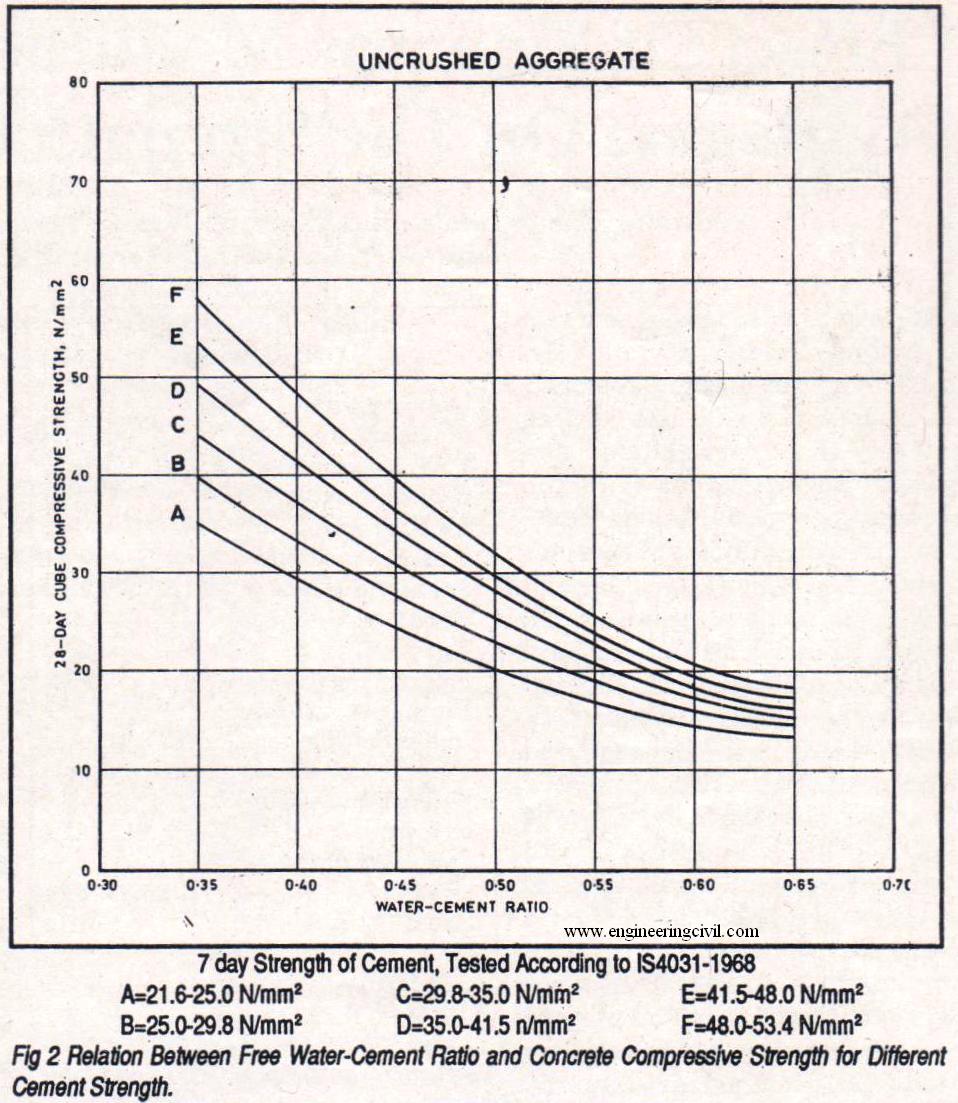
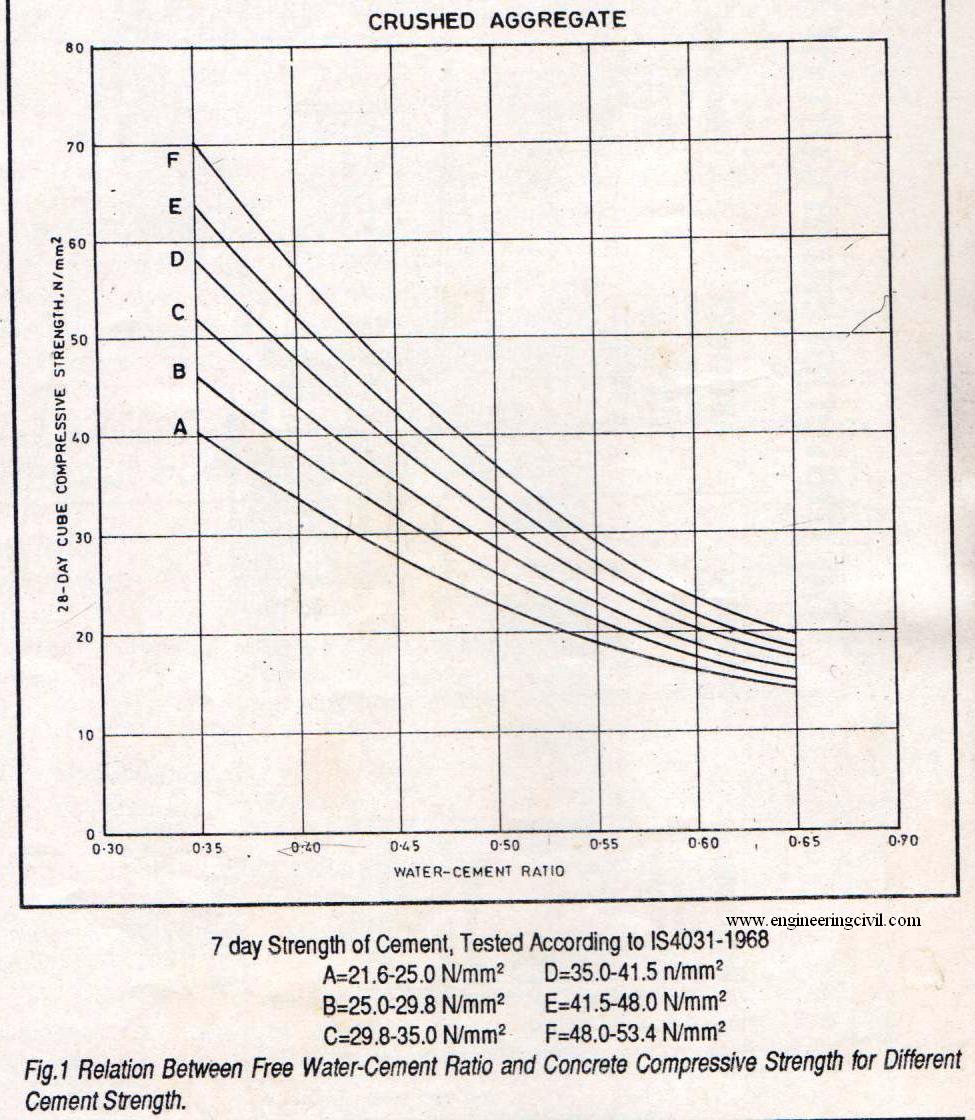
fig-1- relation between free water cement ratio and concrete compressive strength
Knowing the absorption of aggregates, total water and cement content, free water/cement ratio may be determined.
Prediction of 28-Days Strength of Concrete
Cement to be used in construction must be tested and sub-standard cement should not be allowed to be used in the structural concrete. By knowing the cement’s 7-days compressive strength and free water/cement ratio, concrete strength may be predicted from Fig. 1 for crushed aggregate and from Fig.2 for uncrushed (natural gravel) aggregate. These figures were developed by the author from Indian materials by numerous trials.
wet analysis of concrete
A Performa for wet analysis of concrete developed by the author is given here in Appendix A with an example of actual trial. The mix in this case was 1:2:4 on the basis of SSD aggregates by weight and free W/C 0.55; 20 mm maximum size crushed aggregate, river sand of Zone II. The water absorption of coarse aggregate and sand in both was 1% and cement’s 7-days compressive strength was 27.5 N/mm2.
Just after the discharge of concrete from the mixer it was analysed as per the method indicated in Appendix A. The mix ratio by weight and on the basis of SSD aggregates was found to be 1:1.96:4.05 and free water/cement ratio of 0.55.
From Fig. 1 the 28-days strength of this mix of free W/C 0.55 and 7-days cement strength of 27.5 N/mm2 (curve B) was predicted 21.0 N/mm2 This prediction was done within 15 minutes after the concrete was discharged from the mixer. On testing the cubes of this mix at 28-days, the strength was obtained as 21.5 N/mm2.
Conclusion
From this simple method of analysis of fresh concrete, every batch of concrete mix may be predicted for 28-days strength just after discharge from the mixer, and any doubtful concrete mix may be discarded. It must be born in mind that prediction of concrete strength alone at mixer or strength obtained by a cube test is not the sole criterion for good quality concrete, as quality also depends upon many factors including proper placing, compaction and curing.
relation between free water cement ratio

Monday, February 6, 2017

TESTS on Fresh CONCRETE


So what tests are typically run (or would be beneficial to conduct) on a smaller-size construction project? Here's a basic checklist:
ASTM C 172Sampling Freshly Mixed Concrete
ASTM C 1064Temperature of Freshly Mixed Concrete
ASTM C 143Slump of Hydraulic-Cement Concrete
ASTM C 231Air Content of Fresh Concrete by the Pressure Method
ASTM C 173Air Content of Fresh Concrete by the Volumetric Method (Roll-o-meter)
ASTM C 138Density (Unit Weight), Yield and Air Content of Concrete
ASTM C 31Making and Curing Concrete Test Specimens in the Field
The list is not as long as it seems. If you work in the concrete industry, your work or your materials are likely to be affected by these test results. Each procedure or test method must be conducted properly and within the required time frame to be comparable. Fresh concrete tests run along with a set of compressive strength cylinders are: slump, air content, unit weight and temperature. Data from these tests is helpful in assessing mix production and consistency in performance. Although sampling and making and curing test specimens are not test methods per se, they are important practices because subsequent tests depend on the manner in which the concrete was sampled and the manner in which the test samples were made.
For more detailed information on these and other test procedures, visit www.astm.org. Another good resource is ACI 214, Recommended Practice for Evaluation of Strength Tests Results of Concrete, available from the American Concrete Institute.


Sampling (per ASTM C 172) is the first step in determining if the concrete placed complies with specifications. The guidelines are to take composite samples of sufficient total volume (1 ft3 minimum) from the ready-mix truck after 10% and before 90% of the load has been discharged. These samples must be taken no more than 15 minutes apart and remixed to yield a composite sample. They are then covered to protect against rapid evaporation and to avoid contamination.


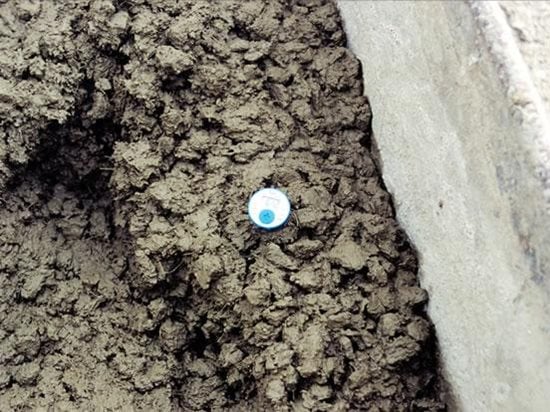
Here, the temperature is being taken after concrete placement, but ideally it should be taken prior to placement to respond to temperatures outside of a specified range. The thermometer is placed to provide at least 3 inches of concrete around the
inserted stem and left in place a minimum of 2 minutes and until the temperature has stabilized.
Start taking temperature measurements of the concrete (per ASTM C 1064) within 5 minutes after securing the remixed composite. The thermometer should be accurate to 1° F. The concrete should be in a wheelbarrow or other suitable receptacle that will permit insertion of the thermometer so that at least 3 inches of concrete surrounds the stem. As long as sufficient concrete surrounds the thermometer in your sample, it should remain inserted for a minimum of 2 minutes while all the other tests are being conducted. After the 2 minutes elapse, the test is complete once the reading remains stable to within 1° F.
Temperature measurements can also be taken in the transporting vehicle or within the forms as long as 3 inches of concrete surround the thermometer. Measuring concrete temperature in the forms (see photo) is not really a recommended practice since the "toothpaste" is already out of the tube. But if the measurement was missed in the rush of getting everything else done, taking the measurement post-placem


Slump tests (ASTM C 143) are applicable for concrete with slumps greater than 1/2 inch and less than 9 inches. Once the concrete sample has been remixed, start taking the slump tests within 5 minutes. Start by filling a mold 12 inches high in the shape of the frustum of a cone that is 8 inches in diameter at the bottom and 4 inches in diameter at the top. Fill the mold in three equal layers by volume, not by height. Rod each layer 25 times with a bullet-tipped 5/8-inch diameter rod to compact each layer. After filling and rodding, raise the cone to allow the concrete to subside. The distance the concrete subsides, or slumps, is based on its consistency.
Measure the amount the concrete slumps or settles from the original height of 12 inches to the nearest 1/4 inch and record as the slump in inches. The measurement is made between the original height of 12 inches and the displaced center of the settled mass of the demolded concrete. If the test falls outside of the specified range, a check test is typically performed to confirm test results.
Testing tip: Since concrete setting is time and temperature dependent, this test must be started within 5 minutes after obtaining the composite sample and completed within 2 ½ minutes after the filling process begins.

Test cylinders (ASTM C 31) are cast to verify the specified compressive strength of the mix has been achieved. Typically 6-inch-diameter by 12-inch-tall plastic molds are used. Some projects use 4-inch-diameter by 8-inch-high cylinders.
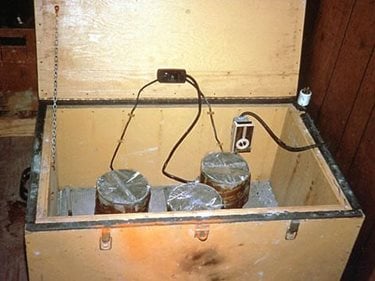
Fill the 6-inch-diameter molds in three equal layers, rodding each layer 25 times. (Fill 4-inch-diameter molds in two equal lifts.) After rodding each layer, tap the outside of the mold to remove any remaining air voids. Once the mold is filled, strike off the top layer of the concrete with the top of the mold and store the molds at temperatures of 60-80°F, leaving them undisturbed. Good field practice would be to place the set of test cylinders in a cure box (shown here) until it is picked up and brought to a lab for curing until the date of testing. Typically a set of four cylinders are cast, with two tested at 7 days and two tested at 28 days. Specifications can, of course, call for other test dates as needed.

A cure box on a level surface with temperature control is ideal for keeping cylinders within the proper temperature range (60-80°F) prior to pickup, up to 48 hours after casting. (Photo courtesy of PCA.)
 
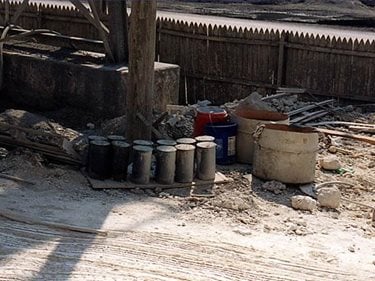
Leaving test cylinders in the sun for too long will cause problems later. Cylinders should be placed on a level surface and protected from the elements for up to the first 48 hours, with the tops covered to prevent moisture loss.
Testing tip: Test cylinders that are poorly made, stored, or neglected will cause headaches and may result in the need for costly hardened concrete testing, all to provide the owner information proving that the actual in-place concrete is of sufficient strength and durability. While this procedure is simple, do not take it lightly. There are a number of reasons why cylinder strengths might be compromised by poor practice, as shown in this table "Effects of Selected Testing Errors".


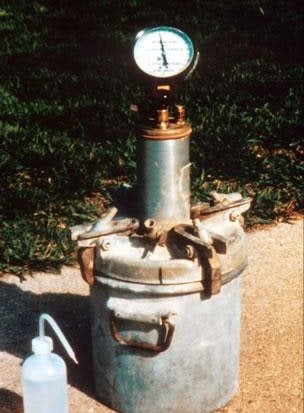
A Type B pressure meter is used to determine the air content of normal-weight concrete. The air content is read at the dial, which is calibrated for each apparatus. The aggregate correction factor (explained in ASTM C 231) must be subtracted from your reading to obtain the net air content. (Photo courtesy of PCA.
Air-entrained concrete is typically specified in areas of the country where frost-related damage can occur. The measurement of air content in fresh concrete of normal density is typically performed using the pressure method (ASTM C 231). Another useful test is ASTM C 173. However, the pressure method is frequently preferred because it is relatively fast.
You should begin the test within 15 minutes after obtaining the composite sample. Start by filling the 0.25 ft3 base of the air-content test device in three equal layers, and rod each layer 25 times. After rodding, strike the outside of the base with a mallet 12 to 15 times to close any air voids. After completing the three equal layers, strike off the bowl flush at the top to completely fill the 0.25 ft3 volume. At this point, it can be weighed as part of the calculation to determine the fresh concrete unit weight.
Next, latch the top of the air-content test device over the base and fill the air gap between the top of the struck-off concrete and the underside of the top of air meter with water. The meter top is then pressurized with the built-in hand pump until zeroed out (or as calibrated). After a stabilization period, release the pressure in the top and read the air-void content on the dial on the top of the meter. Subtract the aggregate correction factor from the dial reading and report the final value.
Testing tip: A typical air content for concrete with a ¾-inch maximum-size aggregate is about 6%, and specified ranges in air content are typically minus 1 ½% and plus 1 ½% of the target value.


The density (unit weight) of concrete (ASTM C 138) is measured using a Type B pressure meter (see photo) to verify agreement with the approved project mix design. The information obtained through this test can also be used to determine yield and relative yield, which helps you verify that you are getting the volume of concrete you ordered and paid for. You can also use this data to calculate the air content of the mix.
The unit weight is determined by the formula below. Subtract the weight of the measuring base from the combined weight of the measuring base and the concrete it contains. Next, divide this weight (in pounds) by the volume of the measuring base (cubic feet) to obtain the density expressed as lb/ft3:
D = (Mc – Mm) / Vm
D=Density of the concrete, lb/ft3
Mc=Weight of the measure holding the concrete
Mm=Weight of the empty concrete measure (base of air meter)
Vm=Volume of the measure (usually about 0.25 ft3 for a pressure meter base) (Fig. 3)
Testing tip: Having the unit weight data gives you "a third point to check a straight line." For example, when slump increases, the air content will generally increase. If significant, look for the unit weight to decrease measurably. If that is not reflected in the test results, keep an eye on the testing and examine the data, procedures, or reporting accuracy.

Condition% ReductionEffect at 10,000 psi
Rough ends before capping277300
Reuse of plastic molds227800
Use of cardboard molds217900
Convex end, capped128800
Eccentric loading128800
Out-of-round diameter109000
Ends not perpendicular to axis89200
Thick cap69400
Sloped end leveled by cap59500
Chipped cap49600
Rebar rodding29800
1 day at 100°F/27 in lab cure118900
3 days at 100°F/24 in lab cure227800
7 days at 100°F/21 in lab cure267400
1 day air/27 days moist89200
3 days air/24 days moist118900
7 days air/21 days moist188200
*NRMCA Publication No. 179
Various improper testing practices can cause strength reductions in test cylinders as demonstrated in this National Ready Mix Concrete Association table. Assuming a 10,000-psi mix strength, the reduction in compressive strength is shown for numerous situations where cylinders where not properly cast, stored, or prepared for testing.